It may be a bit late for this, but I just launched this blog, and I want to include a little list here. A top 10 from last year seems in order. I'm also including my favorite 5 films from this year (thus far). I haven't seen many of 2012's releases that I want to (including Moonrise Kingdom, among others), but the listed five are good films nonetheless.
So, I present, the top 10 films of 2011:
10. Margaret - Filmed in 2006. Released in 2011. Went through Hell in terms of editing. Lonergan couldn't get an approved cut; he brought in Thelma Schoonmaker and Scorsese to edit. Eventually a 150 minute cut was released, in very limited fashion, and ultimately both versions became available on DVD. I've seen both. The 180 minute cut is a messy masterpiece. The acting is top-notch from all around, particularly Anna Paquin, who embodies just about every emotion a teenage girl can possibly go through. My favorite aspect of the film, and it may be minor, are the ADR conversations we're privileged to listen to. Random conversations between random people throughout New York. Neighbors. Passer-bys. Nobody important. It emphasizes this is a film about people, not one person. It's about a culture, not an individual. It's about lives, not a life. It's a messy, brilliantly acted, operatic masterpiece.
9. Young Adult - Charlize Theron turns in her best performance since her Oscar-winning Monster. Patton Oswalt gives his best performance to date. And Diablo Cody shows her maturation as a screenwriter. We're let into the life of an alcoholic writer who spends her days watching the Kardashians and fantasizing about a better life. Soon she returns to hometown Mercury, Minnesota to win back her ex. It's a film about living and existing in the past, and hopefully moving on.
8. The Descendants - I've already written a review for this on my blog, so I won't go into too much detail. This is Payne's most commercially accessible (and emotional) film to date, and showcases Clooney's best performance to date. While it is flawed to some degree, and lacks the perfection of Sideways or About Schmidt, it is still a brilliant, masterful film, deserving of all the awards it won and was nominated for.
7. Tyrannosaur - A bleak, dark drama about two souls who find friendship in one another, but are both seriously damaged, in their own separate ways. The film opens with Peter Mullan killing his own dog with a sledgehammer. How cheery of a film can this be? Containing an appearance by the ever-great Eddie Marsan, this is a film of glorious acting-power (Olivia Colman is an especial highlight), and a great drama, through and through. Bleak, but not to be missed.
6. Drive - The Driver drives. He has no other name. He needs no other name. We know him as the Driver, and that is enough. He lives a content lifestyle - driving a getaway car for heists by night, and existing as a stunt driver by day. He doesn't sleep. The only way he can feel anything is by driving around the streets of Los Angeles at night listening to classic 80s music. Until he meets Irene (Carey Mulligan). He develops a special (non-sexual bond) with her and her child. And then the plot gets complicated, involving Bernie Rose (Albert Brooks), and Jewish gangster Ron Perlman. The Driver represents a true, real superhero - one whose power is not invincibility, or strength, but extreme focus. He's a true Ubermensch, in total control of his world, at least until the balance is upset, and when that happens, The Driver must restore order. He has no other choice. "Ever hear the story of the scorpion and the frog?" The Driver asks Bernie Rose at one point. This is one of the most existential films in years, and the Driver reminds me much of the protagonist of Le Samourai. He hardly speaks. But when he does, you better listen.
5. Take Shelter - Curtis is a working man in northwest Ohio. He works hard, provides for his family, and lives a simple life. Until he starts getting strange visions of disaster. Storms. Tornados. Rain that looks like oil. He's concerned. And so he starts making preparations, to the despair of his wife (Jessica Chastain, in an incredible performance), such as building a storm shelter. Is he taking it too far? Are these visions predictions for the future, or simple insanity? These are the questions Curtis must answer. In possibly the films most harrowing scene, Curtis attempts to attend a simple work lunch. His friend, Dewart, confronts him, resulting in an intense and terrifying scene, and likely the best performance Michael Shannon has ever put to the screen. Along with the climax, which is simple in its details, but complex in its actualities, Shannon should have received an Oscar nomination. It has been a long time since such a simple climax on the page was made so powerful on the screen. That's great acting and directing.
4. Moneyball - This film is The Social Network of baseball. I say that not simply because Aaron Sorkin had a hand in both, but because this truly is the TSN equivalent of baseball. It is not ABOUT baseball. Just as The Social Network is not ABOUT facebook. It's about the man behind. In the case of Moneyball, it's about Billy Beane (Brad Pitt), and his partner in crime, Peter Brand (Jonah Hill, in a brilliantly understated performance, rightfully nominated for an Oscar). Billy comes upon Peter, who was at the time working for the Cleveland Indians, and is inspired by his insight and ideas about baseball (based on a fellow named Bill James). Billy quickly buys him from the Indians, and Peter is now working for the Oakland A's. The film is an artful study in dialogue, and brilliant in its acting. Possibly the best screenplay of 2011, and one of the best films, this is a strong recommend.
3. A Separation - Dialogue is the name of the game with this film. But let's not forget conflict. And conflict there is. It's morally ambiguous. To the point that I had to ask myself - what the fuck would I do? How far does a simple mistake take me, and how far do I deny that I made such a simple error? What are the repercussions of such a mistake? This film takes small pieces of human nature and builds them upon one another, until we must ask ourselves, "at one point is enough enough?" Brilliant entertainment, and no doubt will it live long in your memory afterward.
2. The Kid with a Bike - The Dardennes' brothers. Masters, who have created some of the best Belgian films in history. This is a very simple story of a 12 year old boy (Cyril) who befriends (and becomes much interested in) a woman, Samantha (Cecile de France). He eventually realizes that his father has abandoned him, and honestly wants nothing to do with him. Samantha wants the best for Cyril, and she's willing to care for him. Cyril, however, is not one to follow the rules, so he constantly escapes the confines of the house, and goes out to do whatever he pleases. He gets into some trouble with a local drug-dealer looking to take advantage of Cyril, but ultimately The Kid with a Bike concludes in a satisfactory, meaningful way. Not to mention, Thomas Doret as Cyril gives one of the best child performances of all time.
1. Shame - I cannot say enough good about this film. It mesmerized me from beginning to end. Michael Fassbender is a phenomenon, who should have won the Oscar and just about every other award. Carey Mulligan is also great as his dysfunctional sister. Brandon (Fassbender) is a man who has a problem achieving true pleasure; he masturbates constantly, has tons of porn on his work computer, and has sex with many women, including prostitutes. But does he enjoy any of it? In one of the films most brilliant shots, during a sex scene, the camera focuses not on the physical intimacy or bodily acts, but on Fassbender himself. His face, while having an orgasm, represents not pure pleasure, and not even pleasure at all. But rather, shame. Disgrace. This is the life he leads. Steve McQueen directs a brilliant, amazingly acted, cleverly shot and edited film about sexual addiction. It is the year's best film. I have seen it twice now, and intend to see it a third.
Five favorite films of 2012 so far: 5) 21 Jump Street 4) Chronicle 3) Bernie 2) The Avengers 1) Cabin in the Woods
Sunday, August 5, 2012

Louie Season 3

We're thus far about halfway through the third season of Louis C.K.'s highly popularly, critically acclaimed show Louie. This show just keeps getting better and better. I felt the first few episodes of the first season to be a little rocky, but once season 2 came around, I was entirely on board.
I have to say, this is a show unlike any other I've seen seen. And possibly, unlike any show anyone else has ever seen, but I won't presume to speak for them. And that's probably much of the appeal. This is, through and through, a Louis CK show. He created the show; he writes, he directs, he edits - he even operates the camera at times!

Part of the show's brilliance is its complete lack of any conventional or continuous narrative. You never know what to expect from episode to episode. Sure, many sitcoms are the same way - but not like this. Louis cares zilch about continuity; his sister may be played by one actress here, another there; he may be driving a motorcycle in one episode, and not in another. So what makes this show work so well? Because Louie, more than most any show on television, connects with audiences. The awkward social situations. Louie's own self-image of himself. Everything about this show comes back to relating to your audience. Give them something they can recognize in themselves, and it will resonate. And that's what he does here, to magnificent effect.
This season, thus far, has lived up to the reputation set by the first two. My favorite episode has to be #5, the second episode with Parker Posey (possibly the most interesting character in the history of the series, imo - I hope she returns). The episode ends with a magnificent rooftop scene (some shots in which you'd frankly expect out of something like Woody Allen's Manhattan). Here, Posey discusses why Louie is afraid to get near the edge of the rooftop, while she sits calmly on the ledge. My favorite line, one of the most resonant (for me) in the entire series is when Posey tells Louie: "The only way I'd fall is if I jumped. That's why you're afraid to come over here. Because a tiny part of you wants to jump. Because it would be so easy." I never used to be afraid of heights. These days, a small small part of me is. Maybe that's why.

Louie is a show of brilliance, of wit, of imagination, and one of the best examples of TV originality and "out of the box" thinking I've seen in a long, long time.
****
Fargo Analysis
Fargo: Or How I Learned to Stop Worrying and Love Sarah Palin
Film Breakdown - A Scene By Scene Analysis

This is a scene-by-scene breakdown (with timecodes) of the Coen Brothers' masterpiece Fargo. I personally think it's fascinating from a screenwriting point of view to break a film down into its simple little parts (in this case, 44 distinct scenes - films of this length usually have around 40-45) and be able to more easily see how all the scenes fit together to create what we like to call a "plot," and more importantly, a "story."
The first timecode listed for each scene is the length of the scene. The second timecode at the end (in parentheses) is the minute-mark in the film where the scene ends.
Thus, I give you, the 44 scenes of Fargo, followed by an analysis of the film as it pertains to Blake Snyder's beat sheet. And suffice it to say, this article contains spoilers.
1- 02:52 – Credits (02:52)
2- 3:31 – Jerry Lundegaard enters a bar and meets Carl Showalter and Gaear Grimsrud. He gives them a Cutlass Ciera, and they agree to kidnap his wife in exchange for $40,000. He keeps the other $40,000. (05:23)
3- 2:06 – Jerry returns home to his wife and son. His father-in-law, Wade, joins them for dinner. Jerry tries to get Wade to invest $750,000 in a parking lot. (08:29)
4- 0:56 – Showalter and Grimsrud are in the car, heading for Minneapolis. (09:25)
5- 01:59 – Jerry deals with an angry customer. He shows himself to be a coward who virtually ignores situations when they arise. (11:24)
6- 0:39 – Grimsrud and Showalter have sex with two hookers. (12:03)
7- 1:18 – Jerry receives a call from Wade who says that Stan Grossman might be interested in his parking lot proposal. (13:21)
8- 1:01 – Jerry goes to Shep Proudfoot (who put him in touch with Grimsrud and Showalter) and asks if there is another way to reach them. Jerry wants to cancel the deal. (14:22)
9- 1:40 – Grimsrud and Showalter are nearing Minneapolis. Showalter complains about how little Grimsrud talks. (16:02)
10- 1:28 – Someone calls Jerry asking for the VIN numbers from cars that Jerry received a $320,000 loan on. Jerry acts evasive about it, talking in circles. (17:30)
11- 2:48 – Grimsrud and Showalter break into Jerry’s house and kidnap Jean, Jerry’s wife. (20:18)
12- 3:21 – Jerry meets with Wade and Stan. They offer him a finder’s fee of the $750,000, which Jerry suggests is 10%. He says “that won’t do it for me.” Thus begs the question, if $75,000 isn’t enough, how is $40,000 from the ransom going to be sufficient? (23:49)
13- 1:30 – Jerry returns home to find the place destroyed and Jean missing. He calls Wade. (25:19)
14- 7:24 – Grimsrud and Showalter are pulled over by a trooper. Grimsrud shoots the trooper, and then kills two passing motorists. (32:43)

15- 2:55 – Marge Gunderson, a pregnant Sheriff and the protagonist, gets a telephone call early in the morning informing her about the murders. (35:38)
16- 4:03 – Marge goes to the scene of the crime. Her ability to deduce details from examining the scene suggests a certain brilliance hidden under her Minnesota accent. (39:41)

17- 2:18 – Jerry meets with Stan and Wade. Wade wants to go to the police, but Jerry and Stan urge against it. Stan tells Jerry that they will get $1 million together for the ransom. (41:59)
18- 1:27 – Jerry returns home to find Scotty (his son) upset. He assures him that everything will be okay. (43:26)
19- 1:10 – Showalter and Grimsrud arrive at a cabin in the woods with Jean. They laugh as she runs around, unable to see where she’s going. (44:36)
20- 1:24 – Marge is informed by a Deputy that two people checked into the Blue Ox writing in a Ciera and leaving the tag space blank. (46:00)
21- 1:14 – Marge talks with the two girls with whom Showalter and Grimsrud had sex. She finds out that they said they were heading to the Twin Cities. (47:14)
22- 0:52 – Showalter furiously beats on a TV in an attempt to get a signal. Grimsrud sits and stares, as usual. (48:06)
23- 1:53 – Marge gets a call from Mike Yanagita, an acquaintance from high school. (49:59)
24- 2:35 – Jerry receives a call from Showalter, who demands the entire $80,000. (52:34)
25- 1:34 – Marge receives info from her deputy that a call was placed to Shep Proudfoot. She decides to go to the Twin Cities. (54:08)
26- 1:06 – Wade demands that he be the one to deal with the kidnappers, not Jerry. Jerry, obviously, objects. (55:14)
27- 1:12 – Marge checks in. She makes a call regarding a search on Shep Proudfoot. (56:26)
28- 1:58 – Showalter enters an airport parking deck and removes a license plate from one of the cars. He then argues with the ticket person over the $4 parking fee. (58:24)
29- 1:04 – Marge talks with Shep about who called him. He doesn’t say, but she points out that he’s on parole, and associating with criminals is a violation of parole. (59:28)
30- 1:58 – Marge talks with Jerry. She asks if any cars have gone missing off the lot. He claims that none have. (61:26)
31- 4:01 – Marge meets with Mike Yanagita. He claims to have been married to Linda Cooksey. He breaks down in tears after expressing how much he always liked Marge. (65:27)

32- 1:15 – Showalter eats dinner with an Escort. (66:42)
33- 1:12 – As Showalter is having sex with the Escort, Shep enters and savagely beats Showalter. (67:54)
34- 1:07 – Showalter calls Jerry’s house in anger and demands the money. Wade exits with the money. Jerry follows. (69:01)
35- 3:32 – Wade arrives at the parking deck with the money. He demands to see his daughter. Showalter shoots him and flees with the money. Jerry arrives at the scene and stuffs Wade’s body into the trunk. (72:33)
36- 0:56 – Jerry comes home. Scotty informs him that Stan Grossman called. Jerry lies to his own son as he sits and thinks about how everything is unraveling. (73:29)
37- 2:20 – Officer Olson speaks with a man who says he talked to a “funny lookin’ guy” that was staying up by Moose Lake. (75:49)
38- 2:30 – Showalter discovers that there is well over $80,000 in the satchel. He removes some of the money and buries the rest in the snow. (78:19)
39- 0:55 – Marge talks on the phone with her friend, who informs her that Mike Yanagita was never married to Linda Cooksey. In fact, he stalked her. This tips Marge off to go back and talk to Jerry again. (79:14)
40- 4:14 – Marge goes back to question Jerry. He gets angry and leaves to do a lot-count. She then sees him fleeing the interview. (83:28)
41- 2:23 – Showalter returns to the cabin. He gives Grimsrud the $40,000. Grimsrud demands that the Ciera be split, but Showalter refuses. As Showalter is leaving to take the Ciera, Grimsrud murders him with an axe. (85:51)
42- 3:40 – Marge finds the location of the cabin. She discovers Grimsrud feeding the remains of Showalter into a wood chipper. He flees, and she shoots him in the leg. (89:31)

43- 2:15 – Marge lectures Grimsrud that there is “more to life than a little money.” The police storm down the road to apprehend him. (91:46)
44- 1:05 – Police apprehend Jerry from a motel as he tries to flee through a window. (92:51)
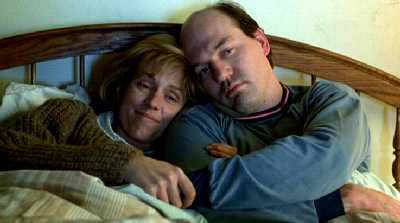
45- 1:33 – Marge and her husband get into bed. They watch TV as Norm talks about his design going on a postage stamp. (93:24)
There are 44 major scenes, with an average run-time of 2 minutes 7 seconds per scene. The longest scene is 7 minutes 24 seconds, which is scene #14... the end of Act I. The shortest scene is scene #22 at 52 seconds in length.
I will attempt to fit Fargo to the Blake Snyder beat sheet, although it should be noted that a lot of films have a somewhat unconventional structure, and most will not perfectly fit the beat sheet. We already know Fargo has an odd structure because we are not introduced to the protagonist until the beginning of Act II.
In fact, I have read quite a few analyses on Fargo, and not one of them has a definitive answer on the structure of Fargo. Screenwriter Todd Alcott (Antz) asserts that Fargo has no protagonist, but rather a “likable main character.” I have read articles to assert that Fargo has dual protagonists. In my opinion, the problem with this assertion is two-fold: 1) Jerry does not have the capacity to pursue his object of desire to the end of the line, and 2) if Jerry is the protagonist, this would make Marge the antagonist. Marge, however, does have the capacity to pursue the object of desire to the end of the line.
However, despite this odd structure, I will attempt to fit Fargo to the Snyder beat sheet.
*Note: I have altered these figures based on a 98 minute running time. Upon completion of the film, I discovered Fargo is in fact 93 minutes long. But, these are approximations anyway.
----------------------
Opening Image (1): Fargo opens on the image of a vast, bleak, snowy landscape. Jerry’s car slices through the falling snow as he arrives at the bar.
Theme Stated (5): There are several themes running throughout Fargo. Often, theme is described as the protagonist’s internal desire. Marge, as our protagonist, is not a character that arcs to a large degree. I do think, however, there is a very nuanced arc. Her external desire is clear: to solve the case and apprehend the suspects. But, what is her flaw? I think the arc in her character lay in her ability to overcome her flaw and accomplish her external desire. How does she accomplish her external desire? By realizing that everything doesn’t have a rational solution. After her encounter with Mike Yanagita, she realizes that maybe Jerry has deceived her. Maybe some things just don’t make sense. Her reconciliation between her flaw (the belief that there is a rational explanation for everything) and external desire is the development of her arc. Thus, the theme is stated when Carl says to Jerry, “it’s like robbing Peter to pay Paul, it just doesn’t make any sense.” Some things just don’t make sense.
Set-up (1-9): Fargo sets up the rest of its plot by introducing all major players (with the exception of Marge). We meet Jerry, Carl Showalter, Gaear Grimsrud, Wade, and Jerry’s family. We also realize that Jerry needs money, for something. He wants an investment from Wade for a parking lot. We don’t know what sort of trouble he is in, nor do we ever know. It doesn’t even really matter.
Catalyst (11): There are several ways to view the catalyst of the film. For one, Jerry’s meeting in the first scene could be seen as the catalyst. It brings Carl and Grimsrud to kidnap Jerry’s wife. The kidnapping itself could also be seen as the catalyst. And, also, the catalyst could be seen as the triple homicide at the end of Act I. Some films push the catalyst to the end of Act I, filling the first act with character introduction and exposition, and then introducing the conflict (Chinatown, Rocky).
Debate (11-23): There is no actual “debate” in Fargo. Fargo utilizes its first act to set-up the introduction of Marge Gunderson, and the multiple threads of the film.
Break into 2 (23): This is when Carl and Grimsrud murder the trooper and then kill the passing motorists. This is the “change of plans” in the plot, and also brings about the introduction of Sheriff Marge Gunderson. Neither Marge nor Jerry propel us into Act II. It’s actually Carl and Grimsrud that bring about the break into 2.
B Story (27): Fargo has no B-story. Unless you wanted to view Marge as the B-story, but I disagree with that notion. Not every film needs a B-story.
Fun and Games (27-49): Marge investigates the crime. Jerry, Wade, and Stan prepare to pay the kidnappers their money.
Midpoint (49): If we assume this is the point of a false victory or a false defeat, it would most likely be the point at which Carl calls Jerry demanding all $80,000. It’s a false defeat because Jerry has told Wade the ransom is $1 million. He isn’t losing all of the money, merely $40,000.
Bad Guys Close In (49-67): Marge closes in on Jerry, Carl, and Grimsrud.
All Is Lost (67): Shep beats Carl as he is having sex with the escort. This would be a false victory. A seemingly good thing turns bad (false victory) when Shep’s violent reaction drives Carl to demand delivery of the money from Jerry.
Dark Night of the Soul (67-76): Carl shoots Wade in anger. Carl takes the entire sum of the money with him. Jerry lies to those around him, even his son.
Break into 3 (76): Marge decides to go back and talk to Jerry, again.
Finale (76-98): Jerry flees the interview. Marge searches for the cabin up by Moose Lake, and finally she finds it. She walks around back to find Grimsrud feeding the remains of Carl into a wood chipper. At the climax, Grimsrud flees across a frozen lake. Marge shoots him in the leg and handcuffs him.
Final Image (98): The final image should be the opposite of the opening image. In Fargo, we opened with a bleak, snowy landscape. We close with the image of Marge and Norm in a warm, cozy bed.
Saturday, August 4, 2012
Bernie
He's An Angel Alright. An Angel of Death.
To my knowledge, I don't know any murderers. But I have to imagine Bernie Tiede is the most lovable, angelic, and affable person to have ever shot an 81 year old woman in the back four times. Linklater, who has provided us with such memorable films as Slacker, Dazed and Confused, Tape, and School of Rock among others, has brought us a sly, dark comedy about a saintly man driven to the edge of sanity and finally being pushed past the breaking point.
The film opens with Bernie giving a lecture about how to dress and present ("cosmetize") the deceased for a funeral. Bernie is an expert at his job. He goes into such detail that he insists the "left hand must be over the right. Over the umbilicus. In an attitude of ease, of repose, of retirement." He's a perfectionist when it comes his job as a mortician. Or, excuse me, he prefers "funeral director."
I should note, this is likely Jack Black's greatest performance. He's subtle. Never goes over the top. Linklater worked with Black in the vastly different, but still enjoyable, School of Rock. But here, Black goes out of the box to embody a man who upon meeting will immediately become your best friend, and yet is capable of something as atrocious as murder. Roger Ebert said in his review of this film, "why did [Linklater] make this film? I suspect he read the magazine article and knew it was a natural movie. Anyone could have seen that. His genius was to see Jack Black as Bernie Tiede." I couldn't agree more.
I should note, this is likely Jack Black's greatest performance. He's subtle. Never goes over the top. Linklater worked with Black in the vastly different, but still enjoyable, School of Rock. But here, Black goes out of the box to embody a man who upon meeting will immediately become your best friend, and yet is capable of something as atrocious as murder. Roger Ebert said in his review of this film, "why did [Linklater] make this film? I suspect he read the magazine article and knew it was a natural movie. Anyone could have seen that. His genius was to see Jack Black as Bernie Tiede." I couldn't agree more.

Linklater, along with co-writer Skip Hollandsworth (best name ever), have interlaced interviews with Carthage, Texas locals who knew Bernie around town with the past narrative of how Bernie came to befriend Marjorie Nugent and ultimately become what amounted to nothing more than her slave, and his ultimate murder of Marjorie. Members of the community regarded Bernie in highly; one fellow townsman dubbed him "the most popular guy in the county." The owner of the funeral loved Bernie; to him, he was a "great find." Bernie even came up with the idea, for $150 extra, to have a dove released into the world as the casket of your beloved was lowered. Bernie wanted to send everybody off into the afterlife in style.
Marjorie, on the other hand, wasn't as popular as Bernie. One citizen said of her: "she'd rip you a new, three bedroom, two bath, double wide asshole." Her own sister expressed that she should probably love Marjorie, but "she's so damn mean."
Bernie took a liking to her. He brought her condolences. Only to get the door slammed in his face. But he wasn't a man to give up, and eventually Marjorie invited him inside, and they struck up a friendship. Bernie was rarely seen talking to women his own age - "women his age were lucky to get the time of day." It was rumored he was gay. District Attorney Danny Davidson (Matthew McConaughey, in a subtlety hilarious and brilliant performance) noted "[Bernie] had a subscription to Men's Fitness magazines, and if you saw Bernie, you know darn well it wasn't for the fitness tips." Nobody cared, though. He was too well-liked.

It's no secret, even before reading this, that eventually Bernie murders Marjorie by shooting her four times in the back. It's a moment of impulse that he immediately regrets afterward. I imagine it's something like that momentary impulse to jump off a bridge if you knew it wouldn't kill you, or you know, hurt like hell. Except in Bernie's case, he was past the point of control, and pulled the trigger. He immediately confessed (after nine months of lying and dodging suspicion).
The film was not as well received by residents of Carthage, Texas, some of whom knew Marjorie. They argue it didn't tell her side of the story. They argue it glorifies murder. I can't disagree with the first assessment, but this is hardly a glorification of murder or violence. It's a blackly comic study of a man, pushed to the breaking point when placed in a position of utter dependence; a man who never tried to deny his crime, but took responsibility for it, and never once felt sorry for himself. Not because he was proud of what he did. But because that's who he was. A man who'd make mistakes and accept the consequences. In that way, Bernie is exemplary of who we should all be - without making such an irreversible, horrible mistake.
My favorite line comes from one of the townsfolk waitresses, as she's talking to D.A. Davidson, trying to persuade him to acquit Bernie: "It's not as bad as people say. He only shot her four times. Not five."
***1/2
Fifty Nominees for the National Film Registry 2011
Every year, any body may nominate up to 50 films (per year) for preservation in the National Film Registry. The only requirements are that they must be at least 10 years old, not foreign, and not currently in the film registry.
I respect this as an important step in film. With the age of digital moving in (which I do not oppose, but recognize its pitfalls), I believe it is important to preserve (in an analog format such as 35mm film), those films that have become cultural landmarks. Those films that mean something to us everyday people. Those films that have merit, and we want to exist forever.
Thus, today, I submitted my list of fifty nominees to the 2012 National Film Registry. We'll see how many are inducted in December (each year up to 25 new films are inducted into the NFR). By the way, I'm not special, anybody can nominate films (so long as they are over 10 years old and not foreign - simply email dross@loc.gov with your list (no more than 50 per year)). No explanation or otherwise required. Just email a list of films, from one to fifty. Nominate them, and perhaps they have a chance of being preserved in the film registry! I believe many of you readers would be shocked by the historically significant films that *are not* currently included in the registry.
This is my list of fifty films I believe should be included, along with a brief reason why. None of these films are currently in the registry. To note: the most recent inductee is Fargo (1996), though films as recent as 2001 are eligible. By the way, Fargo was inducted in 2006, the very year it became eligible. Also to note: This isn't a list of my favorite films (many of which are already in the NFR), but rather a list of films that I consider "culturally, historically, or aesthetically significant."
My list:
My list:
Way Down East (1920) (****)
One of DW Griffith's famous silent films (USA) post-Birth of a Nation. Also one of the few films to include color this early, either via Technicolor or Prizamacolor.
The Circus (1928) (****)
Chaplin. What more needs to be said? He pioneered much of film history. Along with The Gold Rush (a current inductee), this stands as his second best film.
Adventures of Sherlock Holmes, The (1939) (***1/2)
Besides the fact that "Elementary, my dear Watson" was made popular by this film, which ranked #65 on AFI's top 100 quotes of all time? It's a classic mystery, made even more popular by its dialect and popularity as a book series.
Hellzapoppin’ (1941) (****)
This is the first film of its kind I have seen. An outright, outrageous parody film that satirizes films from Citizen Kane (released the same year!) to many others. It's hilarious. It's horrible. It's highly entertaining. And it deserves recognition among the best of all time.
Bad Day at Black Rock (1955) (****)
Director John Sturges. Actor Spencer Tracy (win Best Actor at Cannes, nominee Best Actor Oscar). WGA and Oscar nominees for screenwriter Millard Kaufman. One of Tracy's best performances, and an icon in American cinematic history as a synthesis of the Western and film noir genres. Need more be said? Then see it!
Old Yeller (1957) (***)
Why the fuck do I have to explain this one? Who the hell hasn't seen Old Yeller? Who doesn't recognize that title? In my opinion, that's culturally and historically significant. Enough said on this one.
Anatomy of a Murder (1959) (****)
This is the end-all-be-all of courtroom dramas. Sure, several pre-dated it, but it wasn't until Otto Preminger brought to life this harrowing drama starring James Stewart (one of my favorite actors of the early days). It's twisty, it's intelligent, and all too fascinating to look away from. It's embedded in our culture, and every courtroom drama to this day owes it some due.
Rio Bravo (1959) (****)
Rio Bravo. John Wayne. The rebuke to High Noon (another great film). Tarantino considers this, along with Dazed and Confused, one of the best "hangout" films of all time. Fuck Tarantino (though I love the man). This is more than that. The musical score is haunting. The lack of close-ups is suggestive. It's a fun, entertaining, and an aggressive western that tops (imo) even Hawks' classic "His Girl Friday."
Inherit the Wind (1960) (****)
Inherit the Wind (1960) (****)
Come on! Classic Spencer Tracy. And it's about the Scopes Monkey trial, for fuck's sake. *The* trial that spurred an ever growing chasm between creationism and evolution. While the trial ended in favor of the prosecution, many saw it as a victory for the defense, and it ultimately lit the fuse that would ignite evolution into the standard curriculum for most (if not every) public school in America. Plus, it's a great movie. Need you more?
Birds, The (1963) (***1/2)
I feel little need to explain this one. Classic Hitchcock. Is the idea absurd? Sure. But Hitchcock's style and knack for suspense makes this work one hundred percent. And besides, who hasn't looked at a flock of birds sitting on a power-line and wondered how fucked we'd all be if they all turned against us? Maybe it's just me.
Still, The Birds is a classic that can't be ignored for preservation.
Doctor Zhivago (1965) (***1/2)
This epic, criticized at the time especially for its length, has become a cultural landmark of a film, and is considered today to be one of the finest films of the 1960s. #39 on AFI's top films. #7 AFI's top 10 passions. Nominated for ten Oscars, winning five. Not much explanation needed here.
Who’s Afraid of Virginia Woolf? (1966) (****)
Once again, need I explain this? This a canon in the film world. An exemplary message of what dialogue and acting can bring to a film. Some of the best acting in all of filmdom can be found in this movie.
Rosemary’s Baby (1968) (****)
Roman Polanski's classic horror film. A fantastic Ruth Gordon performance. Rape and impregnation by Satan. #9 on AFI's Top 100 Thrills. One of the most recognizable horror films of all time. I ask you - why shouldn't this be inducted in the NFR?
Roman Polanski's classic horror film. A fantastic Ruth Gordon performance. Rape and impregnation by Satan. #9 on AFI's Top 100 Thrills. One of the most recognizable horror films of all time. I ask you - why shouldn't this be inducted in the NFR?
They Shoot Horses, Don’t They? (1969) (****)
Nominated for nine Academy Awards, winning one for Gig Young as Rocky, this is a film on the surface about a group of people attempting to win a dance marathon. The film is so gloriously over the top (especially for its time period), that it approaches near farce. But Director Sydney Pollack working from a novel by Robert E. Thompson keep material from becoming that. Instead, they use the Depression-era setting to explore the extent to which people will go for money; the greed that can lead to misery, destruction, and even death for others. Looking back on it today, one can certainly draw a comparison between corrupt corporate millionaires and Jane Fonda (one of her best performances) dragging poor Red Buttons across the finish line after him suffering a heart attack. The film's titular line spoken toward the end is one of film's classic moments. It would be a disgrace to ignore a film such as this.
Nominated for nine Academy Awards, winning one for Gig Young as Rocky, this is a film on the surface about a group of people attempting to win a dance marathon. The film is so gloriously over the top (especially for its time period), that it approaches near farce. But Director Sydney Pollack working from a novel by Robert E. Thompson keep material from becoming that. Instead, they use the Depression-era setting to explore the extent to which people will go for money; the greed that can lead to misery, destruction, and even death for others. Looking back on it today, one can certainly draw a comparison between corrupt corporate millionaires and Jane Fonda (one of her best performances) dragging poor Red Buttons across the finish line after him suffering a heart attack. The film's titular line spoken toward the end is one of film's classic moments. It would be a disgrace to ignore a film such as this.
Clockwork Orange, A (1971) (***)
Kubrick, a perfectionist and master of film, brought to life a hellish world in a future dystopian Britain. Initially rated X at the time of its release for sexual violence, this is a film about youth, manipulation, psychiatry, economics, politics, and so much more. Nominated for four Oscars, including Director, Screenplay, and Picture, but winning none, in later years this would go on to be one of the most influential and recognized pictures of all time. Besides, who after seeing this film will ever listen to "Singin' in the Rain" the same again?
Kubrick, a perfectionist and master of film, brought to life a hellish world in a future dystopian Britain. Initially rated X at the time of its release for sexual violence, this is a film about youth, manipulation, psychiatry, economics, politics, and so much more. Nominated for four Oscars, including Director, Screenplay, and Picture, but winning none, in later years this would go on to be one of the most influential and recognized pictures of all time. Besides, who after seeing this film will ever listen to "Singin' in the Rain" the same again?
Klute (1971) (****)
Many haven't seen this brilliant film. But brilliant it is. Starring Jane Fonda (who won an Oscar for her performance) and Donald Sutherland, this is a film about a prostitute attempting to aide an investigator in solving a missing person's mystery. Most notable about this film and its place in history is the cinematography of Gordon Willis. Willis, if you're not aware, would go own to be the cinematography on such films as The Godfather, Godfather Part II, Annie Hall, The Parallax View, The Landlord, Zelig, Manhattan, All the President's Men, among others. Willis reinvented the nature of cinematography. Critic Steven Garrett has said "more than any other director of photography, Willis defined the cinematic look of the 1970s: sophisticated compositions in which bolts of light and black put the decade’s moral ambiguities into stark relief"
Dirty Harry (1972) (***1/2)
"Do you feel lucky?" "Make my day." Who hasn't heard these phrases before? Who doesn't recognize that squinty-eyed Clint with his 44 Magnum? The first Dirty Harry was shocking for its violence, and Harry's transformation into an anti-hero. This is an American classic that sparked numerous sequels over the years, and forever cemented Clint Eastwood as one tough motherfucker (if the Leone films hadn't already).
Texas Chainsaw Massacre (1974) (****)
Before Halloween or Friday the 13th there was The Texas Chainsaw Massacre. Shot on a minimal budget, this film was a huge hit. I can't possibly say it invented the slasher genre; that film would be Peeping Tom, and more well known, Psycho (both released in 1960). However, TCM is the film that sparked the slasher revolution that continued through the 70s into the 80s, and was eventually revived in glorious fashion by Scream.
Before Halloween or Friday the 13th there was The Texas Chainsaw Massacre. Shot on a minimal budget, this film was a huge hit. I can't possibly say it invented the slasher genre; that film would be Peeping Tom, and more well known, Psycho (both released in 1960). However, TCM is the film that sparked the slasher revolution that continued through the 70s into the 80s, and was eventually revived in glorious fashion by Scream.
Carrie (1976) (****)
Working from a Stephen King novel, Brian de Palma brought to the screen what would ultimately become one of the greatest and most iconic horror films of all time. It's relatively standard horror material, but de Palma's style and ability as a director elevated the material to suspenseful and often terrifying heights. One of de Palma's masterstrokes is his pacing - the film is in a constant back and forth between chaos and serenity. One scene may be calm and peaceful, and the next hellish chaos. Above all else, this is a film that go down as likely the most memorable prom scene in history. Everybody knows it. And it's a shocking finale after a suspenseful, masterful build-up.
Working from a Stephen King novel, Brian de Palma brought to the screen what would ultimately become one of the greatest and most iconic horror films of all time. It's relatively standard horror material, but de Palma's style and ability as a director elevated the material to suspenseful and often terrifying heights. One of de Palma's masterstrokes is his pacing - the film is in a constant back and forth between chaos and serenity. One scene may be calm and peaceful, and the next hellish chaos. Above all else, this is a film that go down as likely the most memorable prom scene in history. Everybody knows it. And it's a shocking finale after a suspenseful, masterful build-up.
Heaven’s Gate (1980) (*1/2)
Love it or hate it, this is a film of massive culture and historical value. Produced on a budget of somewhere around $45 million, it grossed only $3 million domestically, collapsed United Artists, and destroyed the career of Michael Cimino (The Deer Hunter). Critically derided and a financial failure at the time of its release, Heaven's Gate was an utter disaster. In recent time, some critics have come to its defense, though it still holds a mere 41% on RottenTomatoes. Most importantly, however, is it's impact on the film industry. Few films have made such an impact. United Artists was sold to MGM, and effectively died. Most importantly, however, it ended the "golden age" for filmmakers. In the 70s, young filmmakers such as Spielberg, Lucas, Coppola, Bogdanovich were given money and essential free-reign to do as they pleased with their films. Not anymore. Not after Heaven's Gate. And to this day, no director holds the power that some did during that golden era. Cultural and historical value? I think fucking yes.
Love it or hate it, this is a film of massive culture and historical value. Produced on a budget of somewhere around $45 million, it grossed only $3 million domestically, collapsed United Artists, and destroyed the career of Michael Cimino (The Deer Hunter). Critically derided and a financial failure at the time of its release, Heaven's Gate was an utter disaster. In recent time, some critics have come to its defense, though it still holds a mere 41% on RottenTomatoes. Most importantly, however, is it's impact on the film industry. Few films have made such an impact. United Artists was sold to MGM, and effectively died. Most importantly, however, it ended the "golden age" for filmmakers. In the 70s, young filmmakers such as Spielberg, Lucas, Coppola, Bogdanovich were given money and essential free-reign to do as they pleased with their films. Not anymore. Not after Heaven's Gate. And to this day, no director holds the power that some did during that golden era. Cultural and historical value? I think fucking yes.
Christmas Story, A (1983) (**1/2)
Initially overlooked at the time of its release (and exactly how many classic films have suffered the same at their inception - MANY), eventually it became a sleeper hit, to the point that every 80s/90s child saw this movie. Even those not in such a category saw this film. It's on at least one cable station at any given time for the two weeks surrounding Christmas to this day. TNT runs it for 24 hours straight, dubbed "24 Hours of A Christmas Story." It's routinely ranked as the best Christmas film of all time. It's a classic, and will exist in the hearts and minds of anybody who has seen it - for many, it holds a great nostalgic value.
Risky Business (1983) (***1/2)
Who doesn't remember Tom Cruise dancing around in his underwear? Not that it was the highlight of the movie for me, but I bet many people remember it. Or driving his father's Porsche off the dock into Lake Michigan? Risky Business is a classic, a film to be preserved, remembered, and respected. It's hilarious with a heart. It's teenage brilliance at its finest.
A Nighmare on Elm Street (1984) (***1/2)
Name me one person who doesn't know who Freddy Krueger is. This is not the first, nor second, in a long line of slasher films, but a magnificent leap forward for Wes Craven, and a huge horror hit. It spawned a terrible sequel starring Rooney Mara and Jackie Earle Haley. It's a classic, through and through.
Ghostbusters (1984) (***)
Honestly? Explanation needed? Fuck you if you do.
The Breakfast Club (1985) (****)
Same as above. If you need an explanation, go fuck yourself.
Blue Velvet (1986) (****)
Perhaps the definitive David Lynch film (alright, along with Mulholland Drive, but Blue Velvet actually makes sense). This is a disturbing, creepy, stylish film that's a undeniable classic. Couple a severed ear and bizarre sexual material with a fantastic Dennis Hopper performance, and you've got a film where the phrase "PABST BLUE RIBBON!" will never be forgotten. Plus, who can forget this scene involving Roy Orbison's "In Dreams":
http://www.youtube.com/watch?v=5-DjluKLY14
Die Hard (1988) (***1/2)
One of the most classic action films of all time, along with Lethal Weapon and The Terminator (currently in the NFR). The career-launching and -defining role of Bruce Willis. #39 AFI Top 100 Thrills. Hans Gruber, #46 AFI Top 100 Villains. And "yippie-kay-yay motherfucker!" A cultural landmark of a film.
Big (1988) (***)
Tom Hank's breakout role, and first Oscar nomination. While these days this story is fairly shopworn (inspiring such films as 13 Going on 30 among others), it was inventive at the time and received virtually universal acclaim at the time of its release. Its status as a funny, smart, and sweet story about child- and adulthood hasn't withered one bit. #42 AFI 100 Laughs, #10 AFI Top 10 Fantasy Films, not to mention: "okay, but I get to be on top."
Glory (1989) (***1/2)
Nominated for 5 Academy Awards (with Denzel Washington winning), this is the true story of the 54th Massachusetts Infantry, the first official entirely African-American infantry unit, and their assault on Fort Wagner which, while unsuccessful, spurred extreme encouragement in the recruitment of black soldiers. The epilogue notes that President Lincoln considered the recruitment of black soldiers key for the Union victory. And this is the story of the men who paved that road.
When Harry Met Sally (1989) (***1/2)
The classic go-to romantic comedy. Friends and sex. Does it work? This an absolute classic, nominated for several Oscars, and sure to go down in the pantheon of great romantic comedies forever and for always.
The classic go-to romantic comedy. Friends and sex. Does it work? This an absolute classic, nominated for several Oscars, and sure to go down in the pantheon of great romantic comedies forever and for always.
JFK (1991) (****)
A wonderfully acted, brilliantly directed, miraculously edited piece of history-based film. Winning two Oscars out of eight nominations (including Best Picture). It was extremely popular, and due to it's popularity, it led to the JFK Act and the creation of the U.S. Assassinations Records Review board, who worked, interviewing witnesses and reviewing records materials, until 1998. It also led to the release of many previously classified documents to the public. Putting aside the historical nature of the film's narrative, how's that for a cultural impact?
Reservoir Dogs (1992) (***1/2)
One of the most influential films of the 90s, along with Tarantino's own Pulp Fiction. Need more be said?
Dazed and Confused (1993) (****)
This is a film about a time. An attitude. A way of life. The beginning of summer. Hanging out, drinking beer, and smoking some weed. It's exemplary of early 70s high school hangouts, and a wonderful film at that. It's about growing up, growing down, and trying to find your place in the middle.
This is a film about a time. An attitude. A way of life. The beginning of summer. Hanging out, drinking beer, and smoking some weed. It's exemplary of early 70s high school hangouts, and a wonderful film at that. It's about growing up, growing down, and trying to find your place in the middle.
Philadelphia (1993) (****)
The first commercial film to openly deal with homosexuality and AIDS. A landmark film in the progress of human history. Up until this film, AIDS patients were treated as a form of a leper. No one wanted to be around them. No one wanted to touch them. This film brought to the mainstream the facts that many others films would not: AIDS is not as contagious as you think; gay people are the same as the rest of us; and discrimination in the workplace is a common problem that needs to be addressed.
Clerks (1994) (***1/2)
Maybe not as groundbreaking as its predecessor: "Slackers" or the brilliance of film that post-dated it: Pulp Fiction. But it's no secret Kevin Smith was highly inspired by "Slackers" and built a ground-breaking, revolutionary film about doing nothing in a convenience store, while still entertaining audiences, around the idea of "Clerks." Say what you want about Smith the director, he's a great writer (his best work to appear in Chasing Amy and Red State), and he took storm of an era where few filmmakers were privileged enough to even make a film. Not that Smith had much money - that's the beauty. He put everything he had into Clerks, and it paid off in spades. A ground-breaking independent film that, along with Pulp Fiction, created a new generation of film.
Pulp Fiction (1994) (****)
This is another film that I feel I have no need to defend in its preservation of film culture. This film was a phenomenon in the 90s (though I shall admit, I was not old enough to experience its true impact at the time of release). But ever since, it has been the pinnacle of 90s indie film. Countless independent films tried to "copy" its success. One of the few "Pulp Fiction" like films that was successful was "Go" : a great, but not so landmark film of its own.
Pulp Fiction practically defined 90s independent cinema, along with Clerks. But Pulp Fiction was the blockbuster that made it. Its pop-culture references, great soundtrack, and wonderful dialogue launched it to one of the best films of all time. In fact, #4 on the IMDB top 250, just 3 behind the #1 of The Shawshank Redemption. 1994 was a year to celebrate.
Shawshank Redemption (1994) (****)
Need I honestly explain the cultural impact of this film? It's existed at the top of the IMDB Top 250 for as long as I've known. It's one of the most universally recognized and beloved films. I don't think I need to offer an explanation as to why this film should be preserved. Someone tell me why it SHOULDN'T.
People Versus Larry Flynt, The (1996) (****)
Cultural value? Historical? Fuck yeah. This is the true story of a man from Nowhereville, Kentucky who built an empire, was arrested numerous times for his work, and took his battle all the way to the Supreme Court, ending in an a decision that will echo forever in American history. Like what Larry Flynt did or not, he fought for freedom of speech. He fought for basic American rights. No question this film should be preserved for it's cultural and historical value. Ironic that it took a Czech like Milos Forman to remind us that freedom of speech isn't selective to what we like and what we don't - it applies to everyone and everything.
Cultural value? Historical? Fuck yeah. This is the true story of a man from Nowhereville, Kentucky who built an empire, was arrested numerous times for his work, and took his battle all the way to the Supreme Court, ending in an a decision that will echo forever in American history. Like what Larry Flynt did or not, he fought for freedom of speech. He fought for basic American rights. No question this film should be preserved for it's cultural and historical value. Ironic that it took a Czech like Milos Forman to remind us that freedom of speech isn't selective to what we like and what we don't - it applies to everyone and everything.
Good Will Hunting (1997) (****)
"How do you like 'dem apples?" This is a brilliant film about a brilliant young man. A young man who'd rather work as a janitor, or construction, than follow his boundless talents. A strong performance coupled with a wonderful Oscar-winning performance from Robin Williams makes for a heartfelt, expertly-written American classic.
Rainmaker, The (1997) (****)
Francis Ford Coppola. Matt Damon, in one of his earliest (if not THE earliest) starring role. Danny DeVito, Claire Danes, Danny Glover, John Voight, Roy Scheider, Virginia Madsen, Mickey Rourke, and Teresa Wright (in her final film appearance). An incredible cast, and a wonderful film. Barely making its $40 millon budget back at the box office, this wasn't a commercial hit. But it spoke to some very true, accurate issues that are, to this day, still issues. It revolves around a young lawyer, taking on a case against Great Benefit Insurance. His client? A sickly boy with leukemia, who was denied coverage by Great Benefit. Fucking insurance companies. The film deals with his legal battles with this company, their faults and general disregard for human life in favor of a few more dollars; it is a film of the time, and still a film for our time.
Titanic (1997) (**)
Okay, so I'm not the biggest fan of Titanic. I think it has solid performances, but the dialogue is atrocious (as is most of James Cameron's dialogue), and the film's melodrama makes me gag sometimes. I don't hate it, but I don't love it. However, its cultural influence and impact is undeniable. The highest grossing film at the time (unadjusted), and now the second highest grossing film behind Avatar, this film was a massive success when released - winning an record 11 Oscars out of 14 nominations, it still stands as the most winning and most nominated film in Academy history. Beyond that, the technical advancements made by Cameron were groundbreaking. It cannot be denied as an amazingly important film.
Big Lebowski, The (1998) (****)
The Dude abides. Overlooked at the time of its release (some even walked out of the theatre), it has since gone on to become one of the most famous of cult-classics. As Roger Ebert wrote, "The Big Lebowski is about an attitude, not a story." And that it is. It's about a man who takes life as it comes, loves his White Russians and weed, and remains chill throughout the entire course of events he encounters. How he manages to pay rent in LA is beyond me, but it matters not. The Dude represents a part of all of us; a part that we sometimes succumb to, a part that sometimes we wish we could embellish in, but ultimately, we can't all be The Dude.
The Dude abides. Overlooked at the time of its release (some even walked out of the theatre), it has since gone on to become one of the most famous of cult-classics. As Roger Ebert wrote, "The Big Lebowski is about an attitude, not a story." And that it is. It's about a man who takes life as it comes, loves his White Russians and weed, and remains chill throughout the entire course of events he encounters. How he manages to pay rent in LA is beyond me, but it matters not. The Dude represents a part of all of us; a part that we sometimes succumb to, a part that sometimes we wish we could embellish in, but ultimately, we can't all be The Dude.
Saving Private Ryan (1998) (****)
Often referred to as one of the most accurate depictions of World War II, especially the opening scene, Spielberg created a masterpiece in Saving Private Ryan. Veterans from the war were reported to have wept when they saw the movie and how accurate it is to the realities of war. Spielberg pulls no punches - he shows us the gruesome, terrifying, and destructive nature of war. A historically significant film with much to say.
Often referred to as one of the most accurate depictions of World War II, especially the opening scene, Spielberg created a masterpiece in Saving Private Ryan. Veterans from the war were reported to have wept when they saw the movie and how accurate it is to the realities of war. Spielberg pulls no punches - he shows us the gruesome, terrifying, and destructive nature of war. A historically significant film with much to say.
American Beauty (1999) (****)
A perfect film. An ensemble created around a protagonist in Kevin Spacey. The writing is brilliant, the direction is perfect, and the cinematography is outstanding. Balanced and even, it evokes the trueness, as well as the depression, of modern suburbia. The performances are beyond outstanding, especially those from Spacey and Bening. Nominated for eight Oscars, winning five including Best Picture, Actor, Director, and Screenplay. A true American masterpiece.
Blair Witch Project, The (1999) (***)
*The* film that launched the seemingly endless string of "mockumentary"/found-footage horror films. Sure, there was Cannibal Holocaust, but who saw that? What other BLOCKBUSTER popularized the found-footage sub-genre? The Blair Witch Project changed film forever, like it or not.
Fight Club (1999) (*1/2)
Another one of those twist endings. Let's be clear. I don't like Fight Club. I actually dislike it a good deal. The first act is brilliant, the second is a portal into teenage male fantasy, and the third is nothing more than outright trickery, undermining all that came before.
But, this list isn't about my favorite films. It's about films that have made an impact. And while Fight Club was initially not so popular, it's since become a cult classic, resting at #11 on the IMDB top 250. Say what you want about it (I say many things), it launched a new era of filmmaking for David Fincher, and is without a doubt one of the most recognizable films in recent history.
Matrix, The (1999) (**1/2)
Let's get one thing clear. I don't like The Matrix that much. I'm not a huge sci-fi fan. It's not a bad movie, but like Titanic, I don't love it as many do. But The Matrix was a visual revolution, greatly talked about at the time, and, as far as I know, essentially created "bullet time," which has been (over)used in many, many films since.
Sixth Sense, The (1999) (****)
Were there films with twist endings before this one? Hell yeah. The earliest example I've *seen* is The Cabinet of Dr. Caligari. Also, Citizen Kane. Les Diabolique. The Sting. Seven. Fight Club. Just to name a very few in the pantheon of film history. But it was this film that inspired countless successive films to try the same tricks (few were done as well). Not to mention, who doesn't recognize the line "I see dead people"?
Were there films with twist endings before this one? Hell yeah. The earliest example I've *seen* is The Cabinet of Dr. Caligari. Also, Citizen Kane. Les Diabolique. The Sting. Seven. Fight Club. Just to name a very few in the pantheon of film history. But it was this film that inspired countless successive films to try the same tricks (few were done as well). Not to mention, who doesn't recognize the line "I see dead people"?
Lord of the Rings: The Fellowship of the Ring, The (2001) (***1/2)
Plain and simple: this film was a visual revolution. It's the 26th highest grossing film of all time worldwide, nominated for 13 Academy Awards (winning 4), and is well known in world-culture, to even those who haven't seen it.
Plain and simple: this film was a visual revolution. It's the 26th highest grossing film of all time worldwide, nominated for 13 Academy Awards (winning 4), and is well known in world-culture, to even those who haven't seen it.
Waking Life (2001) (****)
A visual masterpiece. This isn't the the first film to employ rotoscoping (used as early at 1915, and Disney used it in 1937's Snow White and the Seven Dwarfs. It was used in numerous films over the years, until Linklater took it to a new level, using rotoscoping to create a dream-like effect (all too appropriate for this film). Linklater filmed entirely on camcorders, and then used the rotoscoping process to create this end result, which is not only a meditation on dreams, life, death, the in-between, and existence itself, but also a stunningly gorgeous film.
And here are a few of the films (without explanations) that I imagine, when eligible, I will be submitting to the Registry for consideration. Why? I can see each of these films being culturally, historically, or aesthetically significant in time. We'll see where history takes us.
Avatar, The Hurt Locker, Eternal Sunshine of the Spotless Mind, The Dark Knight, Where the Wild Things Are, The 40-Year Old Virgin, Borat, The Pianist, Good Night and Good Luck, Capote, Up in the Air, Catch me if you Can, The Lord of the Rings: Two Towers and Return of the King, The Social Network, Sin City, Brokeback Mountain, Lost in Translation, There Will Be Blood, No Country for Old Men
The Hunter
About as Popular as a Snake in a Sleeping Bag
Just watched this on Netflix instant, thanks to a good friend allowing me to use her Netflix account.
I liked it. Very much. This is Willem Dafoe's best performance since Antichrist (an amazing, brilliant film, but not for the squeamish). Also one of Sam Neill's best performances. The last I saw him was in the short-lived (cancelled after one season) "Alcatraz," which was a mediocre show at best. Here he is great, in his few short scenes.
I liked it. Very much. This is Willem Dafoe's best performance since Antichrist (an amazing, brilliant film, but not for the squeamish). Also one of Sam Neill's best performances. The last I saw him was in the short-lived (cancelled after one season) "Alcatraz," which was a mediocre show at best. Here he is great, in his few short scenes.
This film opened on a whopping 17 screens in the US, netting a domestic gross of slightly less than $180,000. Why not a wider release? The topic probably didn't appeal to many.
 |
| "Thank you Mr. Mindy, I'd like to go on alone" |
The film regards Dafoe, a mercenary, assigned to go after the thought-extinct Tasmanian Tiger. Not that interesting of a concept, I think you may suspect. I was riveted. It's a great drama, a great thriller, and a highly entertaining film. Australia, along with Korea, Canada, Britain, France, and the USA produce some of the best films in the world. Forthcoming is my review of The Loved Ones, a gruesome but outstandingly entertaining horror film.
During the film, Dafoe says, about the tiger: "It's probably better extinct. If it's alive, people will always search for it. Hunt it...... wonder if he's all alone. Living. Waiting. To die." I empathize.
Available on DVD as well as Netflix instant. I highly recommend if you enjoy a good thriller with beautiful scenery and solid performances.
***
Trailer:
Thursday, August 2, 2012
The Descendants
Lacks the perfection of Sideways, benefits from the charm of Clooney
I saw this film the day it opened at the Arclight on Sunset. It was a magical experience. One of the best theatrical experiences I've had in my day, alongside The Dark Knight and Grindhouse (though, I realize, these are vastly different films in genre, tone, and just about everything else). But it was a great experience in the theatre. I laughed harder than I had in a long time. I had a hangover. It pulled me right out of it. I loved every second.
To be clear, Alexander Payne is one of my top five currently working director/writers. He's never made a bad film; I've loved every film of his since Citizen Ruth, and in my opinion, each successive film has improved. Sideways was a cinematic masterpiece; a perfect screenplay.
The Descendants impressed me a great deal. I loved the acting. I LOVED it. George Clooney gave his best performance of his career, and I still believe that. Shailene Woodley gave a miraculous performance as his daughter. Supporting characters such as Robert Forster and Judy Greer held up their end. It was a phenomenon.
After I first saw it, I declared it to be the "best film I had seen in years." Since then, upon repeated viewings, my initial reaction has dropped. It is not a bad film. It is not a good film. It is still a great one. Just not the great film I initially claimed it to be.
I recently purchased the blu-ray copy of this film, and have viewed it twice more (actually four times more, I just don't want to seem like a bum who just watches movies all day. But I love rewatching films).

As Matt King, George Clooney opens up to us more than he ever has before. He's a complex character full of conflicting and ever-lasting emotions; dealing with the the eminent death of his wife, and other complications, which I shall not reveal for the sake of spoilers. The way he reacts to one of these "complications" is nothing short of perfection.
Flaws? I dislike the narration in the first half hour. I'm all in support of voice over and narration, but in this film, the same could have been achieved through visuals, without any voice over explanation. One good friend of mine criticized the "hamminess" and "over-acting" of Beau Bridges. I can't say I agree, but I don't necessarily disagree. At times, he seems to be attempting to upstage Clooney, and sorry Bridges, that ain't happening. Not in this film.
Other than that? Very few flaws. This is Payne's most accessible film to date (many could not relate to Sideways, or his previous films, though I love them all). Alexander Payne is a director of magnificent but subtle force; he directs his actors through emotions that we all experience in one time or another in our lives, and brings them to the screen in an entertaining fashion. Not only does Clooney embody the sadness, grief, and self-pity of Matt King, but he also exhibits a keen understanding of physical comedy. This isn't a depressing drama. It's a drama, with much comedy interlaced.
The highlights: George Clooney and Shailene Woodley's performances. The gorgeous cinematography (at times) by Phedon Papamichael, who never lets us forget we're in Hawaii. The direction by Payne, who is a master, at this point. I can't say I love this film as much as Sideways, but it is his most commercially successful film to date. And the screenplay by Payne, Nat Faxon, and Jim Rash (of the wonderful and hilarious TV series "Community") is one of the high points of the film. The screenplay is wonderful, nearly flawless, and well deserved of its Oscar for Best Adapted Screenplay.
****
Young Adult
Bourbon, Diet Coke, and KFC
I'll kick this blog off with a little film review. I first saw this film the weekend of its release at The Landmark in Westwood (a theatre whose screens I have a few issues with). Anyway, this was during a period where I didn't sleep for about 10 straight days, so I'm not sure any of what I saw that first time even stuck with me. I saw it again about a month later, and enjoyed it just as much, if not more, than the first go-around. It should be noted I had also read the screenplay, probably a year and a half or more before the release of the film. I enjoyed it greatly, and noted at the time its significance of Diablo Cody's maturation as a writer.
I've recently purchased the blu-ray release of Young Adult and watched it yet again. This is a film of splendid, yet simple, joy. A film about 37 year old writer Mavis Gary (played by Charlize Theron) suffering from "arrested development," and who, upon receiving an email, clings to the hope of winning back her high school boyfriend. What does she do? The appropriate response - packing up, leaving Minneapolis, and heading back to her hometown to essentially stalk this old fling (Patrick Wilson).

While at a bar, getting her nightly routine of drunkenness on, she runs into Matt (Patton Oswalt), a former classmate from high school. He recognizes her. She has no idea who he is. That is, until she identifies him as the "hate crime guy."
Matt and Mavis are the two most fascinating characters in the film, and it is no surprise they give the two best performances. This is likely Oswalt's best performance, and Theron's best since her Oscar winning role in "Monster." The two grow an unlikely friendship through their mutual hatred of the world, and own self-pitying.
Maturely written by Diablo Cody, and well-directed by Jason Reitman, this film brings together some great actors, who bring to life some great characters. One of my favorite lines in the film is when Wilson says to Theron, "you know, you look the same. It's like we all got older and you just got lucky." In many ways, he's right.
***1/2
First Post!
A new avenue through which I can pontificate? Why the fu*k not?
I have just launched this web log, inspired by the many others that I enjoy reading on a daily basis. Also, it just seems to be the new trend these days for everybody and their mother to have a blog, and getting in with the new trends is never bad, right? Though, I can name one or two German trends that were popular for a little while and didn't turn out to be such a great idea.
Anyway, the purpose of this blog is... I don't know. It really has no purpose. No single purpose, I suppose. At the moment, though, it serves to 1) keep me writing on a daily basis, 2) keep me on my toes, as I'll be reading and reviewing scripts on here (a la Carson Reeves fabulous blog "scriptshadow"), and 3) I'll occasionally get to blather on about things I, and only I, care about.
Mostly, I will be talking about cinema. Reviews of films I've seen recently, whether they came out yesterday, or forty years ago. Reviews of scripts I read. And other such film-related talk.
So let's begin.
Subscribe to:
Posts (Atom)